
Inside the Mind of a Writer
Jan Karon shares her thoughts on reading, writing, and
her upcoming book, Party of Four.
- You have a new book coming out called Party of Four.
When will it be released, and can you give our readers a glimpse of its plot?
- Party of Four will be released in the fall of 2010. Since I began the
Mitford series, I’ve wanted to have a look at Father Tim’s Irish heritage,
just as we had a look in Home to Holly Springs at his Mississippi upbringing.
What is Sligo County all about, what is the spirit of the place? What are the
speech habits of its people, the contours of its hills and waterways? To put
it simply, what cultural patterns worked their way into this character’s DNA?
I’ll soon spend three weeks in Sligo, hoping to ken its mystery, if only a little.
As for a glimpse of the novel’s plot, I can’t give you one precisely. I’m
waiting to be surprised. (“No surprise in the author,” said Sandburg, “no
surprise in the reader.”) What I do know is this: The book opens—and closes—on
a train. A family castle, c. 1820, is involved. And a small, furtive fellow with
sallow skin seems to be everywhere at once.
- Do you have any other projects in the works right now?
- I can happily answer: None. None! A short story, maybe. A slow-growing
book of quotes by other authors, perhaps. But nothing to seriously impede
the driving progress of Party of Four. When one sits to write a book, one
must clear the deck or take the desperate consequences. For a long, hard
look at the interior life of an author in the midst of his work, I highly
recommend Steinbeck’s Journal of a Novel, which he kept while writing his
visceral and important East of Eden. He spills the beans all over the place.
Don’t miss it. Bottom line, “other projects” can be dangerous business.
- Did you always know you wanted to be a writer, or did
you have other aspirations before becoming a writer?
- I knew from the time I was 10 years old that I wanted to be an author—like
the people illustrated on the backs of my Author cards. Remember that game? It
was quite mindless, as I recall; it was the visages of the authors that interested
me more. So I got straight to work and wrote a book. It was roughly the length
of Jane Austen’s girlhood work, The History of England, and in it was a heroine
with an 18-inch waistline. No surprise there, as I had just read Gone With the
Wind. By the way, I’m forever amused by what Margaret Mitchell said of her seminal
work: “In a weak moment, I have written a novel.”
- What do you consider the best novel you have ever read?
- You ask me to name the best novel I have ever read and I find that I am
completely and utterly incapable of such a folly. But I will try. How about
Growth of the Soil by Knut Hamsun? Or Independent People by Halldór Laxness?
Or Uncle Remus by Joel Chandler Harris? Or East of Eden by John Steinbeck? Or
almost anything by Eudora Welty? You see? It can’t be done.
- Who do you consider the most inspiring author you have
ever read?
- I must say that I now read very carefully and selectively, and I find them
all inspiring. Flannery O’Connor’s dialect style inspires me; Faulkner’s bravado
inspires me; Gabriel García Márquez’s ability to surprise the reader at every
turn inspires me; and Wordsworth and Herbert and Longfellow continue to call me
to come up higher. I’m thrilled there are so many wonderful authors to read who,
though many of them as dead as doornails, help to restore, refresh, improve, and
enable me as an author. To write well, one simply must do what Faulkner proposed:
Read.
- Are any of your novels based on your life’s experience?
- All of my novels are based on my life experience in one way or another. It is
impossible, I feel, to write outside one’s life experience. This doesn’t mean that
I am Miss Rose Watson (though I sometimes dress like her when I go to the post
office) or Cynthia or even Father Tim or Dooley. But there is something in them
that is very kin to something in me. Indeed, as I write, I process my own life in
ways that are, by turns, difficult or triumphant.
- Besides the room in your home that you wrote about in “A Room
of One’s Own” for the May/June issue of Victoria, are there any other inspirational
spots where you like to go and think?
- You ask where I find inspiration. In libraries and bookstores. On my kitchen
porch. In dreams, in music, in places of all sorts. In trees and poetry and sounds
and scents and humor and conversation. Everywhere. All the time. Waking and
sleeping.
- Is your dog Gracie, who you called “the heartbeat at your
feet,” always at your feet when you write?
- You ask about Gracie, my little SPCA adoptee, and what canine breeds comprise
her cute self, I cannot guess. But she is always around when I write, and deserves
a medal for her patience with me.
- Do you have any “routines” you follow when you write?
- I followed so many routines for so long when I was in the corporate
(advertising) world, that it amuses me now to avoid routine whenever I can.
Of course, such an attitude can do damage to the writing of books, so I try to
write whenever I can, as often as I can. But as for any strict rules, like,
let us say, eight ’til twelve, no, indeed.
- For those Victoria readers who aspire to become successful
writers, can you offer them some advice?
- First, don’t even think about success. This is not something to trouble your
fretted brain with. Read, read, read, and then write, write, write, and if you’ve
got that mysterious component which no one can rightly describe or identify,
you will become successful. I know that sounds like abstract nonsense, so here’s
another thought: Read about writing. Read Brenda Ueland’s marvelous book, If You
Want to Write. Someone, perhaps Sandburg, called it “the best book on writing ever
written.” If nothing else, it will greatly inspire you. And you know, of course,
where inspiration can lead.
- P. S. The most delightful read I’ve enjoyed in a long time is Alan Bennett’s
The Uncommon Reader, given me by Karin Wittenborg, Librarian at the University of
Virginia. Believing that laughter doeth good like a medicine, I highly recommend
it.
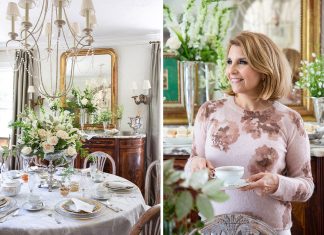
For an intimate view into the world of Jan Karon, see “A Room of One’s Own,”
on page 94 of the May/June issue of Victoria magazine.
Visit www.mitfordbooks.com
for more about Jan Karon and her collection of best-selling novels.